Collective Trusts Hold More 401(k) Money Than Mutual Funds
https://staging.axiomaticdata.com/blogPosts/collective-trusts-hold-more-money-than-mutual-funds
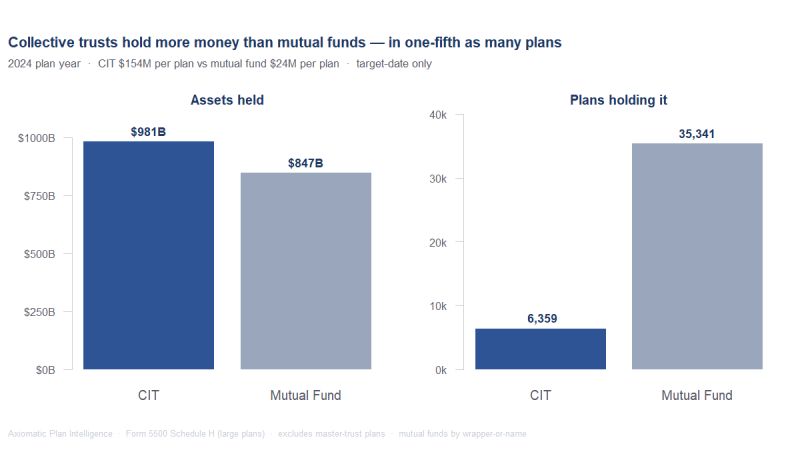
Inside large 401(k) plans, collective investment trusts (CITs) now hold more money than mutual funds, and they do it in far fewer plans.
| Vehicle | Plans holding it | Dollars | Share of fund dollars | Average per holding plan |
|---|---|---|---|---|
| Collective trusts | 27,203 | $3.73T | 58% | $137M |
| Mutual funds | 46,535 | $2.47T | 39% | $53M |
| Pooled separate accounts | 12,112 | $0.22T | 3% | $18M |
It's a plan-size question
| Plan assets | Plans | CIT share of fund dollars |
|---|---|---|
| Under $25M | 30,742 | 11% |
| $25M to $100M | 14,531 | 14% |
| $100M to $250M | 3,835 | 22% |
| $250M to $1B | 2,513 | 43% |
| Over $1B | 1,142 | 79% |
The "trust versus mutual fund" question is really a question about plan size. A CIT is an institutional product: a bank-maintained pool that can offer lower, negotiated fees and is regulated by banking authorities rather than registered with the SEC. Large plans have the scale to negotiate those terms and the consultants to review them. Smaller plans mostly buy what their recordkeeper's platform offers, which is often a mutual fund lineup.
Why it matters
Because the largest plans hold most of the money, the vehicle they choose sets the market's direction. Managers building new products for 401(k)s, including alternatives sleeves, increasingly launch them as trusts first. Mutual funds remain the way most plans, by count, invest.
About the data
Figures cover 401(k) plans with more than 100 participants that list their holdings on Schedule H of Form 5500, for plan year 2024 (52,763 plans). Dollars are the plans' holdings in mutual funds, collective investment trusts (CITs) and pooled separate accounts on the Schedule of Assets Held.
Every plan, fund and manager behind these numbers is in Axiomatic Plan Intelligence. For more information, email us at info@axiomaticdata.com.
Updated November 2026 with figures from the latest complete plan year (2024). The original LinkedIn post used an earlier version of our data, so some numbers differ.
Originally posted on LinkedIn.